
I-10 After Dark: Timing, Heat, and the Southwest Freight Corridor
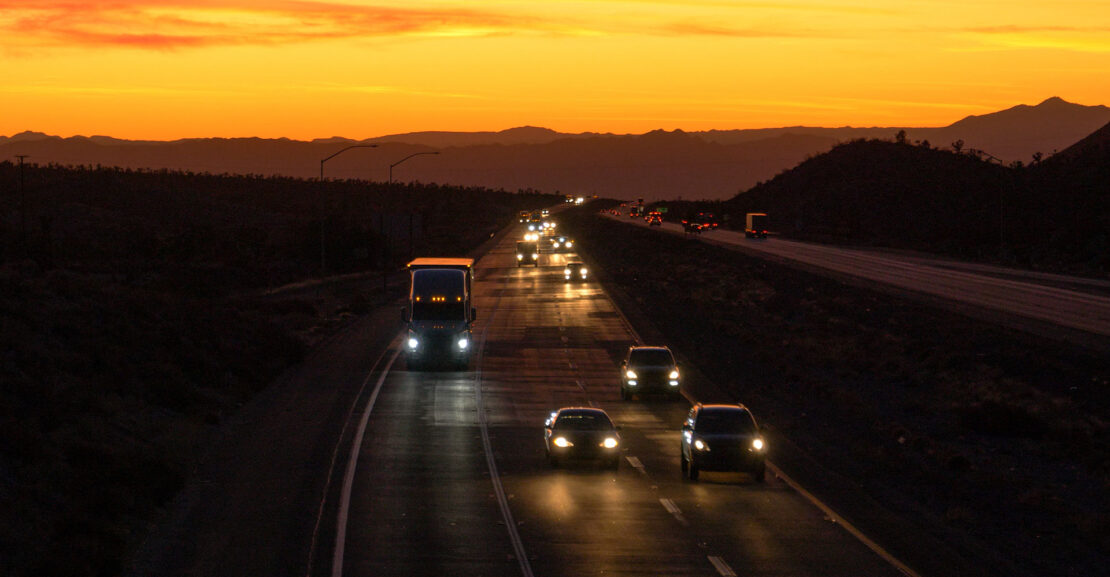
A truck leaving Southern California late in the day can experience several different operating environments before the next morning. Dense traffic around the Inland Empire gives way to open desert. Temperatures begin to fall. Phoenix gets closer. The road may feel easier.
That makes nighttime travel across I-10 appealing. Yet the decision is more complicated than simply waiting for sunset.
Moving freight efficiently across the Southwest freight corridor requires fleets and dispatchers to work around several schedules at once. Temperature changes by the hour. Congestion rises and falls around major cities. Drivers have legal and physical limits on how long they can operate. Customers have their own receiving windows.
The challenge is getting all of those clocks to line up.
Why I-10 Matters to the Southwest Freight Corridor
I-10 is one of the most important east-west freight routes in the country, and its role becomes especially visible across Southern California, Arizona, New Mexico, and Texas. It connects major population centers, distribution markets, manufacturing areas, border trade routes, and long stretches of rural highway.
It is also a corridor where operating conditions can change quickly.
A truck moving east from Southern California may start in one of the busiest freight markets in the United States. It then crosses long desert stretches before entering Phoenix, one of the fastest-growing metropolitan markets in the Southwest.
From there, I-10 continues through Tucson, across eastern Arizona and New Mexico, and toward El Paso. Farther east, the same corridor connects with major freight activity around San Antonio and Houston.
Those sections do not behave the same way.
Urban traffic can dominate one part of the trip. Heat and distance may matter more in another. In rural sections of eastern Arizona, commercial trucks can account for a substantial share of total highway traffic even when overall traffic volumes are relatively low.
That variation makes I-10 a useful example of modern corridor planning. A route can look straightforward on a map while demanding very different decisions from hour to hour.
Why Night Driving Can Look Attractive on I-10
There are obvious reasons for fleets to consider moving some freight later in the day or overnight. The sun disappears. Temperatures begin to retreat. Some commuter traffic clears. A truck may be able to cover long stretches with fewer interruptions.
Those benefits are real, but they have limits.
Summer temperatures across the desert Southwest can place additional stress on trucks, drivers, tires, cooling systems, and refrigerated equipment.
Leaving later may help a truck avoid part of the afternoon heat cycle. Nighttime temperatures can still be high, particularly after a day of extreme heat, but removing direct solar exposure can make conditions more manageable.
For some operations, that creates a useful window for moving between major markets.
A late departure may also position a truck for an early arrival, allowing the fleet to move while portions of the corridor are relatively quiet rather than spending peak daylight hours in traffic.
Nighttime Creates a Different Set of Constraints
Less traffic does not automatically mean an easier trip.
Parking may become harder to find as the night progresses. Driver alertness can decline during overnight hours. A departure that clears one city perfectly may put the truck into the next metropolitan area during morning rush hour.
That is why nighttime scheduling works best when it is treated as part of a larger route strategy.
The question is not simply whether the truck should leave after dark. It is where that departure time will place the truck several hours later.
Extreme Heat Changes Southwest Trucking Operations
Heat deserves its own place in Southwest freight planning because its effects extend beyond driver comfort. Prolonged high temperatures can expose equipment problems that may remain unnoticed under easier conditions.
Night operation can help, but preparation still matters.
High ambient temperatures contribute to higher tire temperatures. Underinflated tires are especially vulnerable because greater sidewall flex creates additional heat.
That means tire pressure, tread condition, fluid levels, belts, hoses, cooling systems, and other basic maintenance items deserve close attention before a long desert run.
A truck that is already marginal mechanically has less room for error when outside temperatures remain high for hours.
The same principle applies after sunset. Desert pavement and equipment can retain significant heat well into the evening. A nighttime departure should not be treated as a substitute for heat-season maintenance.
Refrigerated Freight Adds Another Layer
Refrigerated operators have additional variables to manage.
Long periods of extreme heat can make temperature-controlled equipment work harder, especially during frequent stops, loading delays, or extended periods with doors open.
Route timing may help reduce some of that demand, but equipment condition remains the foundation. A well-planned departure cannot compensate for a cooling system or refrigeration unit that is already struggling.
I-10 Traffic Has Its Own Clock
Traffic congestion is one of the strongest arguments for thinking strategically about departure times. Several major I-10 interchanges appear regularly in national truck bottleneck studies, including locations in Southern California, Phoenix, and Houston.
The important lesson is that congestion needs to be considered across the entire run.
Suppose a truck leaves Southern California at a time that avoids afternoon congestion. That looks like a win.
But where will the truck be five or six hours later?
If the answer is Phoenix during a heavy traffic period, some of the earlier benefit may disappear. The same problem can occur farther east around El Paso, San Antonio, or Houston. Phoenix’s own growth is reshaping this part of the equation — our related piece, The Valley’s Delivery Math: How Phoenix Growth Changes Route Planning, looks at how that growth is changing route math for fleets moving through the area.
Strong dispatch planning works backward and forward.
Instead of asking only when a truck should depart, planners should consider when it will reach each major congestion point along the route.
Small Timing Changes Can Have Large Effects
An hour may not look significant when planning a long-distance route, but that hour can determine whether a truck reaches a city before traffic builds or directly in the middle of it.
Construction makes this even more important.
Arizona, for example, continues to invest heavily in I-10 capacity between Phoenix and Tucson. Those improvements are important for long-term freight movement, but major highway projects can create temporary lane shifts, work zones, and changing traffic patterns.
Schedules should have enough flexibility to absorb those variables without putting the entire delivery window at risk.
Driver Hours Shape Long-Distance I-10 Planning
Every freight plan eventually meets the driver’s available operating time. Federal Hours of Service rules define how long a driver can operate and when breaks must occur, but good planning goes beyond basic compliance.
A theoretically perfect traffic window has little value if the driver cannot realistically use it.
For most property-carrying drivers, federal rules allow up to 11 hours of driving after 10 consecutive hours off, within a 14-hour on-duty window. Break requirements also shape the day.
Where those breaks occur can influence the entire trip.
A planned stop can provide fuel, food, parking, and rest while positioning the truck for the next section of the route. An unplanned stop may happen wherever the driver’s clock forces it to happen.
That distinction becomes more important across long rural stretches where services may be farther apart.
Overnight Fatigue Cannot Be Ignored
Nighttime driving introduces another clock: human alertness.
The period between midnight and early morning corresponds with a natural low point in the body’s circadian rhythm. A driver who is accustomed to daytime work may not perform the same way simply because traffic is lighter at 2 a.m.
This creates one of the central tradeoffs of Southwest freight planning.
The coolest and quietest part of the day may overlap with the hours when maintaining alertness becomes more difficult.
Good scheduling accounts for both.
Truck Parking Is Part of Freight Capacity
Truck parking is easy to think of as a driver issue, but it is also an operational issue. A highway can have plenty of physical capacity while a driver approaching the end of available hours has very few practical places to stop.
That makes parking part of corridor planning.
Nationally, truck parking remains tight, with industry research estimating roughly one available space for every 11 drivers.
Arizona has responded with plans to expand truck parking along major interstate routes, including I-10, but demand remains an important consideration.
A driver who waits until the end of the available driving window to look for parking may discover that the most useful locations are already full.
Planning several potential stopping points ahead of time provides more flexibility.
It can also prevent an ironic outcome: a fleet saves time by avoiding daytime congestion, then gives some of that time back searching for parking late at night.
The Four Clocks of Southwest Freight Planning
The most useful way to think about I-10 may be as four overlapping schedules. None can be optimized completely in isolation.
The strongest route plan finds a workable balance among all four.
The Heat Clock: When will the truck encounter the highest temperatures? That question can influence departure time, inspection priorities, fuel planning, refrigerated operations, and where longer stops occur.
The Traffic Clock: When will the truck pass through Southern California, Phoenix, Tucson, El Paso, or another major urban area? A small schedule adjustment may prevent a significant amount of stop-and-go driving.
The Driver Clock: How much driving time is available, when will breaks occur, and when is the driver likely to be most alert? The driver’s schedule has to fit the route rather than being added after the route is already planned.
The Delivery Clock: Finally, when can the customer actually receive the load? There is little value in arriving three hours early if the facility is closed. Conversely, an overly tight receiving appointment can turn a small traffic or weather delay into a service problem.
The best plan works backward from the delivery window while considering the other three clocks.
Build More Margin Into Southwest Freight Routes
Southwest freight movement rewards preparation because the distances are long and conditions can change quickly. Heat, dust, construction, crashes, congestion, and parking shortages all have the potential to disrupt a schedule.
The goal is not to predict every problem. It is to create enough flexibility that one problem does not unravel the entire run.
That may mean identifying alternate break locations, preparing equipment carefully before hot-weather runs, giving drivers realistic arrival windows, or having additional fleet capacity available during busy periods.
It can also mean using a different truck configuration when the route or workload changes.
For companies moving freight between Southern California and Arizona, Suppose U Drive can provide rental, leasing, and fleet maintenance support from locations that serve both sides of this important regional corridor. That added flexibility can help businesses respond when freight volumes change, equipment goes down, or a route requires additional capacity.
The larger principle is simple: the more demanding the corridor, the more valuable operational options become.
I-10 After Dark Is Really About Better Timing
There is no single best hour to cross the Southwest.
Nighttime travel can offer lower temperatures, lighter traffic, and productive highway miles. It can also introduce fatigue, tighter parking availability, and the possibility of reaching the next major city at exactly the wrong time.
The strongest freight operations do not choose day or night in isolation.
They plan around heat, traffic, driver time, and customer time together.
On I-10, those four clocks can determine whether a long desert run feels controlled and predictable or becomes a series of small delays stacked on top of one another.
And across the Southwest freight corridor, timing can be every bit as important as distance.
FAQs
Is it better for commercial trucks to travel I-10 at night?
Nighttime travel can reduce exposure to peak afternoon heat and may help avoid some congestion, but it also creates considerations involving fatigue, parking availability, and arrival timing. The best departure time depends on the full route and delivery schedule.
Why is I-10 important to Southwest freight?
I-10 connects major freight and population centers across Southern California, Arizona, New Mexico, and Texas. It also provides important connections to distribution markets, border trade, and other interstate freight routes.
How does extreme heat affect commercial trucks?
High temperatures can increase stress on tires, cooling systems, fluids, refrigeration equipment, and other vehicle components. Preventive maintenance and pre-trip inspections become especially important during extended desert operations.
Why does truck parking matter to route planning?
Drivers need legal and practical places to stop before reaching their Hours of Service limits. Parking shortages can force earlier stops, add unplanned mileage, or create delays if suitable spaces are unavailable.