
The Valley’s Delivery Math: How Phoenix Growth Changes Route Planning
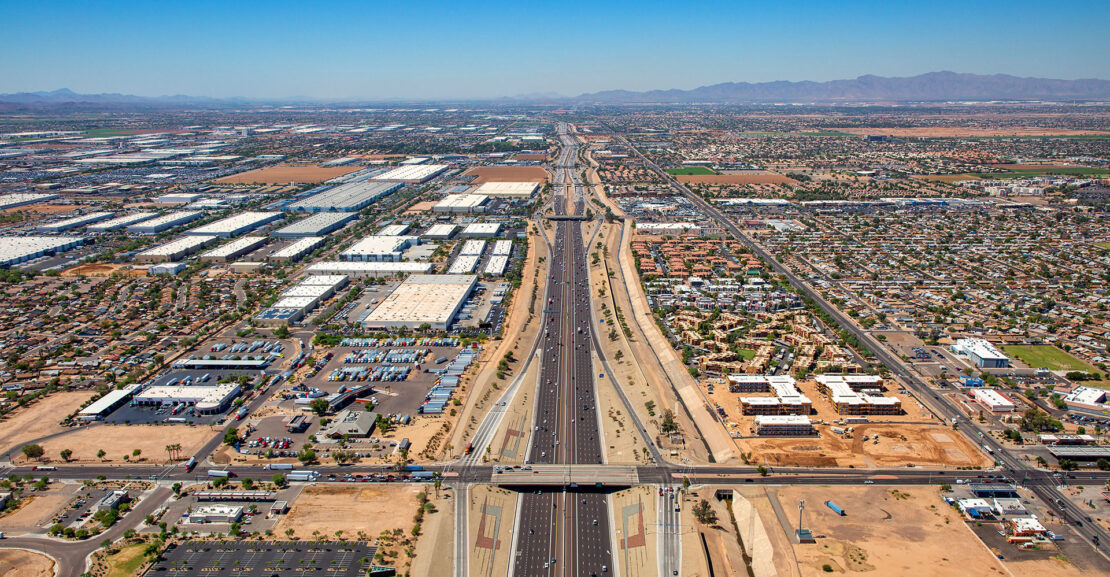
Phoenix keeps getting bigger. More homes, more industrial space, more businesses, and more people are spreading across a metro area that was already known for covering a lot of ground.
For delivery fleets, that growth creates opportunity. It also changes the math.
A route that worked well a few years ago may now include customers farther west, new stops in the Southeast Valley, an industrial park north of the city, and a familiar receiving dock whose neighborhood has become noticeably busier. None of those changes seems dramatic on its own. Together, they can reshape an entire delivery day.
The challenge for fleets planning Phoenix delivery routes is recognizing that growth does not automatically produce efficiency. More stops can create better route density, but only when those stops are in the right places, at the right times, and connected by roads that allow trucks to move predictably.
In a market as geographically diverse as Phoenix, distance tells only part of the story.
Phoenix Growth Is Creating Multiple Delivery Markets
It is tempting to think of Phoenix as one enormous service area. Operationally, that is becoming less useful.
Growth is occurring in several directions at once. The West Valley continues to expand around communities such as Glendale, Goodyear, Avondale, and Buckeye. North Phoenix has attracted significant manufacturing and industrial investment. Mesa, Chandler, Gilbert, and Queen Creek continue pushing the Southeast Valley outward.
Meanwhile, central Phoenix, Tempe, and Scottsdale remain major commercial destinations with their own traffic patterns and delivery constraints.
The result is a metropolitan area that increasingly behaves like several connected delivery markets.
A customer in Buckeye and another in Mesa may both be labeled “Phoenix metro” on a sales report. From a dispatcher’s perspective, they are very different stops.
That distinction becomes important as businesses grow. Adding five customers does not necessarily make an existing route five stops denser. Those customers might extend the territory another 20 or 30 miles.
Growth can increase revenue while quietly decreasing route productivity.
Better Phoenix Delivery Routes Start With Time, Not Mileage
Mileage remains useful, but miles alone are a weak measure of delivery efficiency.
Consider two routes.
One truck travels 100 miles and completes 14 deliveries concentrated within a relatively compact territory. Another travels 75 miles but completes only nine stops because the driver spends more time crossing congested corridors, waiting at receiving docks, and moving between widely separated customers.
Which route performed better?
Probably the longer one.
Fleet productivity is ultimately constrained by time. Every delivery day contains a finite number of working hours, and those hours get divided among driving, loading, unloading, customer service, traffic, paperwork, and waiting.
That makes several measurements particularly useful when evaluating Phoenix delivery routes:
Miles per stop. Are customers getting farther apart?
Minutes per stop. How much of the day does each completed delivery actually consume?
Stops per productive hour. Is the route becoming more or less efficient as the territory grows?
Deadhead mileage. How much driving occurs without accomplishing a delivery or repositioning toward one efficiently?
Dock dwell time. How long does the truck remain at a customer after arriving?
A fleet can still have plenty of room inside its trucks while running out of hours in the day.
That is an important distinction.
Route Density Can Disappear Quickly Across Metro Phoenix
Route density sounds simple. Put more stops closer together and the truck becomes more productive.
Phoenix complicates that calculation because geographic expansion can occur faster than customer concentration.
Imagine two trucks carrying the same number of deliveries.
The first serves 12 customers clustered in the West Valley. The second also has 12 deliveries, but they are scattered among Glendale, central Phoenix, Mesa, and Queen Creek.
Both trucks leave with similar workloads. Their operating days may look nothing alike.
The second route introduces more freeway transitions, longer gaps between stops, greater exposure to congestion, and more opportunities for a single delay to disrupt everything scheduled afterward.
A late first stop becomes a late second stop. The late second stop misses a receiving window. Now dispatch is calling the third customer.
This is how a route can become inefficient without appearing overloaded.
The truck has enough cargo space.
The driver does not have enough time.
Phoenix Traffic Reliability Matters More Than the Shortest Route
Routing systems are very good at calculating distance. Dispatchers need to think about something more difficult: predictability.
Phoenix freight movement relies heavily on major corridors such as I-10, I-17, Loop 101, Loop 202, and Loop 303. These roads connect many of the Valley’s largest population centers, industrial districts, warehouses, and commercial areas.
They also create natural choke points.
That means the shortest path between two customers is not necessarily the most dependable one.
A route that saves six miles but regularly encounters unpredictable delays may perform worse than a slightly longer alternative with steadier travel times. The difference becomes more significant when several scheduled stops depend on one another.
Five minutes does not sound like much.
Five minutes multiplied across traffic, a late dock, another freeway interchange, and four remaining appointments can become an hour surprisingly fast.
For Phoenix fleet planning, reliability deserves to be treated almost like distance. The question is not simply how many miles separate two customers. It is how consistently a truck can cover those miles at the time it actually needs to travel them.
Dock Timing Changes the Entire Delivery Schedule
Traffic gets much of the attention in route planning, but the road is only one part of a delivery.
Reaching the customer does not mean the stop is finished.
A driver may still need to check in, wait for dock access, locate receiving personnel, unload freight, collect paperwork, and exit a crowded facility.
Sometimes that takes 15 minutes.
Sometimes it takes 45.
Receiving hours can also limit a fleet’s ability to avoid traffic. Leaving the yard earlier does little good when the first customer will not accept a delivery until 8:00 a.m.
That makes dock appointments anchor points for the entire route.
Suppose a driver has an 8:00 a.m. West Valley delivery followed by a 10:00 a.m. appointment on the other side of the metro area. Those are not two independent stops. The first customer’s receiving process directly affects the probability of reaching the second on time.
The schedule needs enough resilience to absorb normal variation.
Without it, dispatch spends the day recovering from the route instead of managing it.
Phoenix Industrial Growth Is Changing Where Routes Begin and End
Industrial development adds another layer to the equation.
Warehousing and distribution activity has expanded substantially in the West Valley, while manufacturing investment has created new freight demand in north Phoenix and other developing parts of the region. The Southeast Valley continues to grow as well.
That shifts the origin-and-destination map.
A distribution facility may remain in the same location for years while its customers, suppliers, employees, and service territories gradually move outward.
Eventually, yesterday’s route structure no longer matches today’s business.
Fleets should periodically look at where their trucks are actually spending time. Are West Valley vehicles repeatedly being sent east? Are East Valley deliveries being added to a route that already struggles with afternoon return times? Are trucks crossing central Phoenix simply because that is how the route has always been organized?
Historical routes can become habits.
Growth makes those habits expensive.
Plan Phoenix Delivery Routes Around Corridors and Zones
ZIP codes are convenient for organizing customers. They are not always the best way to organize trucks.
A more practical approach is to think about Phoenix as a collection of operating zones connected by major corridors.
A West Valley route might concentrate on Glendale, Tolleson, Avondale, Goodyear, and Buckeye.
A north Phoenix route could serve customers around Deer Valley and developing industrial areas near I-17 and Loop 303.
An East or Southeast Valley route might focus on Mesa, Chandler, Gilbert, and Queen Creek.
Central Phoenix and Tempe may support denser stop counts but introduce different challenges, including tighter delivery windows, greater local traffic, and more variable access conditions.
The boundaries do not need to be rigid. The point is to understand which stops naturally work together.
Two customers can be relatively close on a map and still belong on different routes because getting between them at 2:30 p.m. creates too much uncertainty.
Local operating knowledge becomes valuable here.
The best route is often the one that makes sense after you’ve driven it 50 times.
Avoid Cross-Valley Deliveries When the Math Does Not Work
There is a natural tendency to maximize the amount of freight placed on each truck.
Usually, that is good fleet management.
But a full truck is not automatically a productive truck.
Suppose adding one final delivery raises vehicle utilization from 85 percent to nearly 100 percent. On paper, that looks efficient.
Now suppose that stop requires an additional freeway crossing, adds 25 miles, introduces a narrow receiving window, and keeps the driver out another hour.
The fuller truck may actually cost more to operate.
A useful question for dispatchers is not only:
Can this delivery fit on the truck?
It is:
Does this delivery fit the route?
That small shift in thinking matters as Phoenix continues expanding.
Sometimes leaving space on one truck and placing the delivery on another route tomorrow produces better overall fleet productivity.
Growing Phoenix Fleets Can Run Out of Geography Before Capacity
Businesses usually think they need another truck when the existing vehicles are full.
Phoenix can create another scenario.
The trucks still have cargo capacity, but the routes no longer have enough time capacity.
The signs tend to appear gradually:
- Drivers return later than they used to.
- Stops per day begin declining.
- Overtime increases.
- Missed delivery windows become more common.
- Trucks spend more time crossing the Valley.
- Dispatch regularly pushes stops into the following day.
- Deadhead mileage rises.
- Vehicles leave with available cargo space because another stop would make the route too long.
At that point, an additional vehicle may solve a geographic problem rather than a payload problem.
Splitting one large territory into two denser routes can reduce windshield time, improve schedule reliability, and create room for additional growth.
For fleets adapting to growth, that can also make flexible vehicle capacity valuable. Adding a rental truck to separate a sprawling route, cover a developing territory, or handle a temporary increase in stops gives operators room to test the new delivery math before making a longer-term fleet decision.
Local Phoenix Market Knowledge Is Becoming a Fleet Advantage
Software matters. Data matters. Route optimization matters.
So does knowing the Valley.
A dispatcher who understands that a particular interchange behaves differently at 7:30 a.m. than it does at 10:00 knows something important. So does the driver who knows which customer regularly needs an extra 20 minutes at receiving.
Those details accumulate.
Which industrial areas become congested around shift changes?
Which customers can reliably take early deliveries?
When does crossing from the West Valley to the East Valley make operational sense?
Which route looks inefficient on a map but works surprisingly well in practice?
Where is construction changing an established pattern?
When should one territory become two?
Good Phoenix fleet planning combines technology with that local experience.
A routing platform can calculate the miles.
The operation still has to understand what those miles mean.
Smarter Route Planning for a Growing Phoenix Market
Phoenix growth creates enormous opportunity for businesses that move products, equipment, food, materials, and freight throughout the Valley.
But growth changes routes long before it necessarily changes the number of trucks sitting in the yard.
New customers appear farther apart. Industrial centers shift. Receiving schedules tighten. Familiar corridors become less predictable. A route that once had room for three more stops suddenly has room for one.
That is the new delivery math.
The fleets that recognize it early can adjust territories, rethink schedules, separate routes, and add flexible capacity before inefficiency becomes part of the daily routine.
Because in a market growing as quickly and broadly as Phoenix, the most important number may not be how many miles a truck travels.
It may be how much useful work happens between them.
The right number isn’t how many trucks you own — it’s how much useful work they can do. Suppose U Drive can help you find it.
For operators weighing whether this kind of growth is temporary or permanent, our related piece on commercial truck leasing in Phoenix looks at when expansion starts to justify a longer-term commitment. Suppose U Drive’s Phoenix location team works daily with the routing and capacity challenges unique to this market.
FAQs
Why are Phoenix delivery routes becoming more difficult to plan?
Population, housing, industrial, and commercial growth are occurring across multiple parts of the metropolitan area. As delivery territories expand, fleets may encounter longer distances between stops, additional freeway crossings, changing congestion patterns, and greater variability in delivery times.
Is the shortest Phoenix delivery route always the most efficient?
No. A slightly longer route may be more productive if travel times are more predictable. Congestion, receiving windows, dock delays, and the location of subsequent stops can matter more than a small difference in mileage.
How does Phoenix sprawl affect fleet costs?
Greater distance between customers can increase fuel use, driver hours, deadhead mileage, and the amount of time required per completed delivery. It can also reduce the number of stops a truck can realistically complete in one shift.
When should a Phoenix fleet consider splitting a route?
It may be worth evaluating when drivers consistently return late, stops per day decline, overtime increases, trucks repeatedly cross the Valley, or missed delivery windows become more common.
Can a business need another truck even when its current vehicles are not full?
Yes. A fleet can run out of available route time before it runs out of cargo space. An additional truck can help divide a large territory into denser, more manageable delivery zones.
For guidance on matching the vehicle to the job once you’re on-site, see our related piece on Box Truck, Stakebed, or Crew Cab? Picking the Right Truck for Phoenix Jobsite Work.