

The Arizona Advantage: How the Southwest’s Distribution Backbone Is Taking Shape
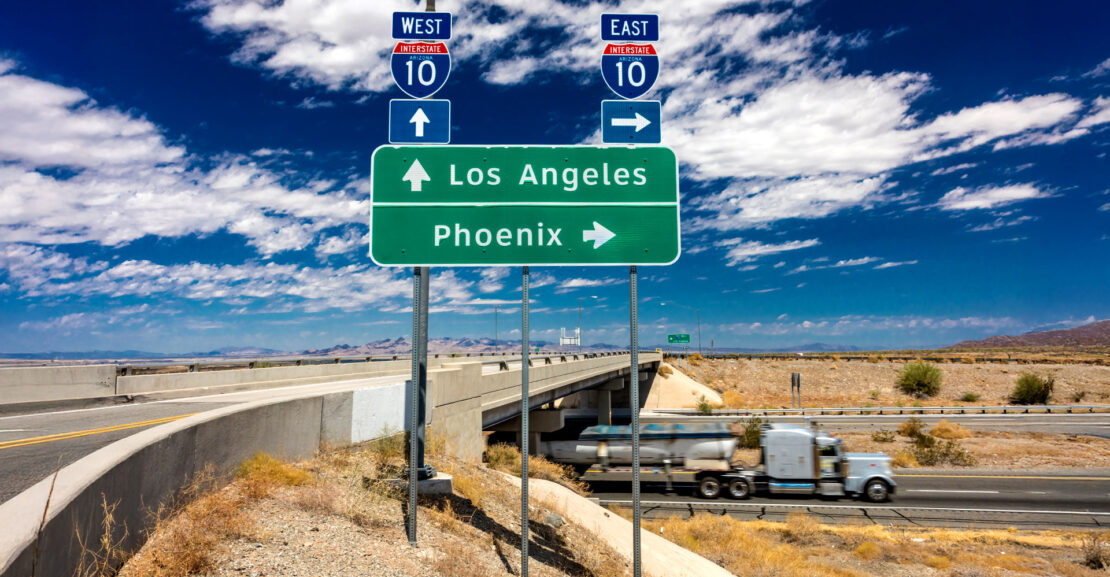
Arizona used to be treated like the space between markets. A clean line on a map. A drive-through state on the way from Southern California to Texas, or a convenient reload before heading north. That story persists, but it no longer explains what is happening on the ground.
Today, Arizona is starting to function like a distribution backbone for the Southwest. Not a single-node hub, but a connected system that supports regional reach, steadier replenishment, and smarter network design. Phoenix sits at the center of it, and it is the city most people see first. But the advantage is bigger than Phoenix alone.
Arizona’s Distribution Backbone Starts with a Simple Shift
A distribution backbone is not a marketing label. It is a pattern you can feel in daily operations. Freight stops drifting through and starts stacking up. Warehouses stop being “nice to have” and become essential. The market stops behaving like overflow and starts behaving like an anchor.
What a “distribution backbone” really means
In practical terms, a backbone state does a few things well. It supports inventory placement that can reliably serve multiple states. It offers enough capacity and routing flexibility to absorb surges. It provides the corridor structure that keeps freight moving when plans change.
Backbones also create density. As more facilities cluster, networks get tighter. You see more scheduled runs, more repeatable turns, more predictable middle-mile flows. The freight becomes less incidental and more designed.
Why backbones form over time, not overnight
Backbones do not appear because one big building goes up. They form when multiple forces line up at once: demand growth, land availability, corridor access, and a steady stream of companies deciding to place inventory closer to where it needs to go next.
Arizona is hitting that inflection. The compounding effect is real. Between 2019 and 2023, the Phoenix metro added 58.9 million square feet of distribution and warehouse space, ranking fourth in percentage growth and fifth in total square footage added among the top 20 U.S. metros. Every added node makes the next node easier to justify.
The Statewide Drivers Behind Arizona’s Logistics Momentum
Arizona’s rise is not driven by one sector or one headline. It is the result of broad demand, expanding industrial activity, and a geographic position that fits how distribution networks want to operate now.
Population growth and consumer pull
Distribution follows demand. When a region grows, replenishment volume rises with it. Not in one dramatic spike, but in thousands of small, daily needs. Grocery, retail, construction supply, home improvement, healthcare, hospitality. The basics.
Arizona added 97,000 residents between July 2024 and July 2025, representing a 1.2% growth rate that continues to outpace the national average. Since 2011, the state has added nearly 1.3 million people, a 20% increase. That amounts to roughly 266 new residents every day.
Arizona benefits from being both a destination and a connector. As population expands across metro areas and suburban rings, companies look for ways to shorten delivery promises and reduce expensive long-haul swings. That pulls inventory inland, closer to the interior Southwest customer base.
Industrial expansion that changes freight mix
Consumer goods are only part of the story. Arizona’s economic growth also supports higher mix freight: equipment, components, specialized materials, facility support, and ongoing MRO needs. In fiscal year 2024, Arizona attracted companies that committed to creating 24,251 new jobs with an average wage of $75,701 and over $50 billion in capital investment.
The semiconductor and electric vehicle sectors are reshaping the state’s industrial profile. TSMC’s $65 billion investment across three Phoenix fabrication plants, Lucid’s manufacturing expansion in Casa Grande, and the broader supplier ecosystem are creating demand for specialized logistics that goes far beyond retail replenishment.
That matters because diversified freight tends to stabilize volumes. It reduces the “all retail, all season” problem. When a region supports both consumer demand and industrial activity, distribution planners start treating it as a long-term platform. That is how backbone behavior becomes durable.
Geography that supports multi-state coverage
Arizona sits in a position that makes coverage math work. From a network design perspective, it offers a practical way to reach the interior Southwest without forcing everything to originate on the coast. It is a place where inventory can be staged and redistributed efficiently.
Phoenix sits roughly six hours from the ports of Los Angeles and Long Beach, often enabling goods to reach inland distribution centers quickly once they move out of the coastal system. That proximity matters. But so does the distance from other markets. From Phoenix, freight can reach Southern California, Las Vegas, Albuquerque, and El Paso within a single driving shift.
That does not replace Southern California. It complements it. It gives networks a second anchor point that can protect service levels and reduce ripple effects when the coastal system is under strain.
How Arizona compares to other Southwest options
Arizona is not the only Southwest market with distribution potential. El Paso plays a major role in cross-border trade and manufacturing supply chains. Albuquerque sits at the crossroads of I-40 and I-25, offering a central regional position and rail connectivity. Las Vegas benefits from proximity to key Western markets and a development environment that can be attractive for staging and redistribution.
But Arizona offers a combination that is hard to match: rapid population growth, large-scale industrial investment, statewide corridor connectivity, and close proximity to both coastal ports and interior markets. El Paso leans cross-border. Albuquerque leans central coverage. Las Vegas leans Western edge staging. Arizona increasingly serves the region as a whole.
The Arizona Logistics Map Is Taking Shape Around Corridors
Arizona’s advantage is not just where it is. It is how freight can move through it. Backbone states are corridor states. The road network and the land use patterns combine to create predictable distribution zones.
The corridor effect that attracts warehouses
Warehouses do not spread evenly. They cluster along corridors that support quick access, scalable footprints, and repeatable inbound and outbound patterns. Over time, those corridors become self-reinforcing. More buildings create more carrier density. More carrier density improves service options. Better service options attract more tenants.
This corridor logic is one of the clearest reasons Arizona feels different now. The state is not just adding square footage. It is building a distribution map that makes routing decisions simpler.
In Phoenix, the West Valley has emerged as the primary warehousing submarket, with direct access to Interstate 10 and Loop 101. Walmart’s $152 million purchase of a 1.27 million-square-foot facility in Glendale signals continued confidence in this corridor. Industrial rents in Phoenix average $14.90 per square foot, compared to $18.40 in Los Angeles, creating a cost advantage that reinforces the corridor’s appeal.
Supporting nodes that feed the system
A backbone is rarely one city and nothing else. It is usually a hub supported by multiple feeder zones. In Arizona, you can see this in how networks start to divide functions.
Casa Grande has become a logistics anchor in its own right. Located at the intersection of I-8 and I-10, the city offers direct interstate access to both the Phoenix and Tucson metros, service along Union Pacific’s main line, and access to three international airports within about an hour. With substantial pre-zoned industrial land available at a fraction of metro costs, Casa Grande has attracted semiconductor suppliers, chemical logistics facilities, and manufacturing operations. Recent logistics and manufacturing investments in the corridor reflect Arizona’s expanding advanced manufacturing ecosystem, reinforcing the area’s role as practical infrastructure for industrial growth.
Tucson serves a different function. Positioned along the Arizona-Sonora trade corridor, the city benefits from I-10 and I-19 access and proximity to key border crossings. International Logistics Solutions opened a 115,000-square-foot distribution center in Tucson in 2025, designed to support cross-border freight flows and nearshoring operations. Tucson’s role as a cross-border staging point complements Phoenix’s hub function without duplicating it.
Some nodes lean toward industrial support and specialized supply chains. Others serve as staging areas for regional distribution. Some operate as overflow and peak-season relief valves. These supporting roles matter because they keep the hub from being overloaded, and they create resilience when demand shifts.
The statewide story is connectivity. The Phoenix story is concentration. Together, they create a system.
Why Phoenix Becomes the Hub of the Hub
Phoenix is not the entire Arizona advantage, but it is the engine room. If Arizona is a distribution backbone, Phoenix is the vertebrae where the most motion and weight accumulate.
Freight gravity and operational density
Phoenix concentrates the things distribution networks need: large industrial clusters, labor availability, freeway interchanges, and a high frequency of inbound and outbound moves. Density creates optionality. More facilities means more route choices. More route choices means better scheduling outcomes.
It also creates a more repeatable rhythm. Freight patterns become less improvisational. You see more dedicated runs, more planned shuttles, more structured appointment compliance. For fleet operators, that can mean more consistent work, but it can also mean tighter expectations.
In a national distribution and warehousing market ranking, Phoenix placed second behind Dallas-Fort Worth, reflecting how quickly the metro has scaled. But the growth trajectory matters as much as the current position. The continued addition of specialized industrial facilities, the expansion of semiconductor and EV supply chains, and the ongoing diversification of freight types all point to a market that is still gaining momentum.
Phoenix as the natural extension of Southern California logistics
Southern California remains a dominant gateway and consumption market. But many networks are rethinking how much of their interior Southwest service should depend on the coastal system alone.
Phoenix offers a practical answer. It is close enough to function as an extension of Southern California distribution, yet far enough to provide breathing room. That makes it an ideal second anchor for inventory positioning. Companies can stage freight inland, then push it into multiple interior markets with fewer fragile dependencies.
This is how Phoenix shifts from “helpful overflow” to “planned platform.” The difference is intent.
How Freight Flows Are Changing Across the Southwest
As Arizona strengthens, freight flows start behaving differently. You see changes in where loads break down, where they consolidate, and where they get re-timed.
Inland staging and redistribution
One of the biggest changes is the rise of inland staging. Freight comes in, gets sorted, and goes back out on shorter runs. This is not just a warehouse story. It is a network cadence story.
Inland staging supports faster replenishment. It supports multi-stop routing. It supports more precise appointment scheduling for downstream facilities. It also reduces the operational impact of variability at the coastal edge.
When staging becomes normal, a market starts behaving like a backbone.
More “middle-mile” work, less pure pass-through
As distribution systems mature, middle-mile work grows. That includes shuttles between facilities, transfers to meet appointment windows, and redistribution runs that keep inventory balanced across a region.
This is where Phoenix and Arizona shine together. The statewide corridor structure supports movement, and the Phoenix metro density creates enough demand for repeatable middle-mile lanes. That combination makes it easier for carriers and fleet managers to plan consistent utilization.
Multimodal optionality without the complexity tax
Most distribution still runs on highways. That is the reality. But backbone states often benefit from having multiple modes available when needed. Rail-served industrial activity and airport cargo can add optionality for certain freight types and urgency levels.
Phoenix Sky Harbor International Airport continues to support time-sensitive freight. The key point is not that every shipment shifts modes. It is that networks gain choices. Choices improve resilience. That is part of what makes a backbone valuable.
What This Means for Fleet Operators and Distribution Teams
Arizona’s backbone role changes the nature of work. It pushes more freight into scheduled systems and increases the number of “local decisions” that can make or break service.
More appointments, more precision
As hubs mature, appointment expectations get stricter. Facilities are busier, windows are tighter, and missed slots are more costly. That affects how fleets schedule drivers, stage equipment, and manage delays.
It also increases the value of responsiveness. When a dock time changes or a trailer needs to be repositioned quickly, slow processes become expensive.
Different trip shapes and equipment needs
Backbone distribution work often includes more multi-stop runs, more short turns, and more shuttle moves between facilities. That can shift equipment needs in subtle ways.
Box trucks, straight trucks, liftgate-equipped units, and refrigerated equipment often become more important as distribution patterns diversify. Not every operation needs all of these, but hub markets tend to demand a broader mix over time.
A stronger case for flexible capacity
Backbone growth is not perfectly smooth. It comes in waves: new facility launches, customer onboarding, seasonal peaks, and network realignments. Even well-run fleets can struggle when they try to cover every surge with permanent assets.
Flexible capacity becomes a strategy, not a last resort. It lets operators cover spikes, protect service levels, and keep core assets assigned to the most profitable, repeatable lanes.
Where Suppose U Drive Fits in an Arizona-First Distribution Story
Arizona’s distribution backbone is creating more moments where businesses need equipment quickly, for a defined purpose, without a long commitment. That is where a work-focused rental and leasing partner earns its place.
Facility launches and expansions create messy phases. Volume grows before processes fully stabilize. Routes change. Requirements evolve. Fleets often need additional equipment to bridge the gap, then scale back once operations settle. Suppose U Drive can support those transitions with work-ready commercial trucks and flexible terms that match real project timelines. The goal is simple: keep freight moving while the network finds its new rhythm.
Peak season and promotional surges do not always justify adding permanent units. But they do demand coverage. Rentals can help fleets add capacity for a defined window, then return to baseline without dragging costs through the rest of the year. In a backbone market, agility is a competitive edge.
In hub-driven distribution, downtime hurts more because the schedule is tighter. Local support and fast, straightforward maintenance coordination can make the difference between a missed week and a missed quarter. This is not about fancy promises. It is about keeping equipment available when the market is moving fast, and it is exactly where Suppose U Drive fits.
Arizona Is Becoming a Planning Point, Not a Route
Arizona’s rise as a Southwest distribution backbone is the result of compounding forces. Demand is growing. Industrial activity is expanding. Corridors are filling in. Networks are repositioning inventory inland. Phoenix is concentrating the gravity and turning statewide advantages into daily operational momentum.
The numbers tell part of the story. Nearly 59 million square feet of new warehouse space in five years. A population adding roughly 266 residents per day. Over $50 billion in committed capital investment. Companies from TSMC to Walmart making long-term bets on the region.
But the real shift is harder to quantify. It is the moment when distribution planners stop asking “Can we use Arizona?” and start asking “How do we configure our Arizona footprint?” It is the transition from reactive overflow to proactive staging. It is the recognition that the Southwest needs a backbone, and Arizona is becoming it.
For distribution teams, the takeaway is clear. Arizona is no longer an afterthought in Southwest network design. It is becoming a core planning point. And Phoenix is the hub that makes the entire system work at scale.