

Santa’s Supply Chain: What the North Pole Can Teach Fleet Managers
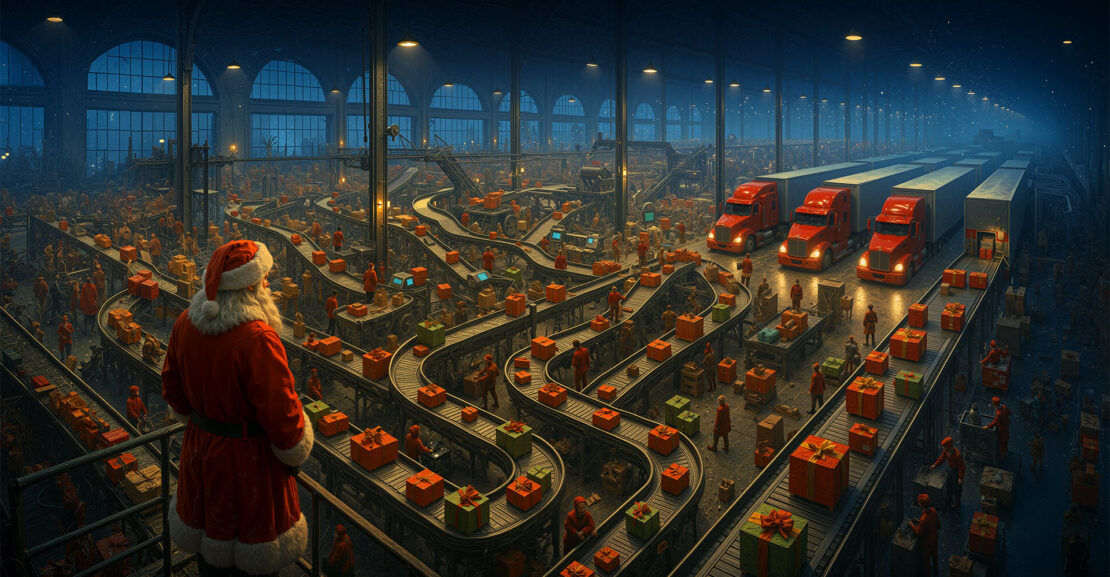
Somewhere between the first peppermint mocha and the last overnight shipment, a legend quietly hijacks every logistics conversation. One night. Every household. Perfect on time performance. Zero tracking links, zero “your shipment is delayed” emails. Children call it magic. Anyone who has ever tried to keep trucks moving in December knows it sounds a lot like a service level agreement with a sense of humor.
While Santa may or may not be real, the pressure his legend creates absolutely is. Customers, retailers, and supply chain partners have been trained on the idea that the impossible might actually be reasonable. That is why Santa is more than a cute metaphor. He is the unofficial benchmark for what people wish the holiday supply chain could be.
If you look at the North Pole as a thought experiment instead of a fairy tale, it starts to reveal some sharp lessons about planning, flexibility, and fleet strategy. Not a step-by-step playbook. More like a mirror that shows what happens when every weak point in a network is suddenly pulled tight on the same night.
This is where the fun begins. Because once you accept that you don’t have flying reindeer or time travel, you can get serious about the practical side of building a holiday supply chain that still feels a little bit magical.
The North Pole as The Ultimate Peak Season Operation
Imagine the North Pole as an actual facility. There is a year-round planning office, a manufacturing wing, a maintenance bay for the sleigh, and something that looks suspiciously like a global control tower. Put it under fluorescent lights, and it starts to look less like a children’s book and more like a demanding seasonal account.
The most striking feature is the shape of Santa’s demand curve. Eleven and a half months of quiet data collection, letter reading, and forecasting, followed by a single blinding spike. No holiday creep, no staged promotions, no extended delivery windows. One night. Hard deadline.
Supply chains in the real world spread that peak across several weeks, but the physics are similar. Volumes build, surge, and finally break in waves. Black Friday and Cyber Monday. Expedited shipping cutoffs. Last-minute in-store replenishment. The calendar keeps moving. Trucks, drivers, and planners try to keep up.
In that environment, Santa is less a cheerful mascot and more a constant reminder of how demanding peak season really is. The story makes it look easy. The reality is closer to a chess match played in a snowstorm.
Year-Round Planning: Santa’s Secret Is Steady Discipline
The real work begins long before the sleigh leaves the barn. If you look beneath the glitter of the story, what Santa really has is an obsessive planning culture. He knows his customer base, he tracks their preferences, and he treats information as a strategic asset.
In practice, the North Pole operates like a demand planning engine that never shuts off. Every wish list is a data point. Every address is a location record. Every change of heart about a toy is a forecast adjustment. The elves are not just building toys, they are working off a constantly updated plan.
Fleet managers who survive Q4 year after year tend to have a similar streak. They live in the spreadsheets long before the first snowflake hits a windshield. They study last year’s holiday season, not to admire their survival, but to spot the fragile parts of the network. A lane that always runs hot in the second week of December. A customer who treats “firm volume” as a polite suggestion. A region that seems to summon bad weather on command.
The lesson from the North Pole is not that you need more data. It is that you need a better relationship with the data you already have. Numbers become useful the moment you let them change your assumptions. That is when a story about a man in a red suit turns into an early warning system for your own fleet.
Flexible Capacity: Santa’s Backup Reindeer and Your Extra Trucks
Stories rarely dwell on this, but Santa doesn’t bet everything on a single reindeer or a single sleigh. There is a bench. There are backups. There is redundancy woven into the whole operation, because even in a fairy tale, things can go wrong.
Holiday freight has the same appetite for surprise. A retailer wins a campaign that performs better than expected. A port delay pushes arrivals into the tightest part of the calendar. A vehicle that was supposed to be back from the shop loses a fight with black ice. The network is already warm. Suddenly, it’s boiling.
This is where the idea of flexible capacity stops feeling like a finance phrase and starts looking like a survival tool. If every truck in your fleet is already fully committed during the holidays, you are not flexible, you are exposed. One bad day can turn into a cascading set of failures.
Santa solves this with extra reindeer and a sleigh that never seems to need maintenance. Fleet managers have to be more creative. They blend owned assets, long-term leases, and short-term rentals into a capacity portfolio that can react when the curve bends upward.
Partners like Suppose U Drive step into the story here. When you can add vehicles quickly without changing your balance sheet for the next five years, you shift from hoping the spike is manageable to managing it deliberately. Instead of saying no to profitable loads or stretching drivers beyond reasonable limits, you can pull supplemental trucks into the operation, then release them once the surge passes.
The North Pole model is clear. Having a backup is not a luxury. It is core infrastructure dressed in a red hat.
Routing The Impossible: From World Tour to Real Streets
One of the most ambitious parts of the Santa story is the route itself. Every country, every city, every rooftop, all in one night. It’s an extraordinary feat, which is exactly why it is so useful as a thought experiment.
If you think about how Santa might approach this challenge with the same constraints we face, the only way he succeeds is by squeezing inefficiency out of every mile. That means dense clusters of stops, smart sequencing, and a ruthless focus on distance between deliveries. The moment you picture him crisscrossing continents at random, even the magic becomes harder to imagine.
Holiday fleets face a milder version of the same problem. Not enough time, too many stops, and routes that grow more chaotic as more last-minute orders slip in. The trucks don’t have to visit every address on earth, they just have to cover enough ground to keep service commitments believable.
The fleets that handle this well are the ones that treat routing as a design problem, not just a software screen. They think in terms of neighborhoods and patterns. They examine which distribution points really need to serve which territories. They look at a congested urban route and ask whether a different vehicle type might ease the pain.
Vehicle choice matters here. Santa can take one sleigh everywhere. You cannot. A twenty-six-foot box truck that glides down a regional highway might become a challenge in a crowded downtown on the last Saturday before Christmas. Conversely, a small unit that dances through city traffic is a poor choice for a long linehaul between distribution centers.
What the Santa story does is exaggerate these constraints until they become impossible to ignore. It dares you to imagine a perfect route, then challenges you to move your own operation a few inches closer to that ideal each year.
Efficiency Under Pressure: The Workshop That Never Wastes a Step
If you walk through the North Pole workshop in your mind, you will not see a lot of improvisation. There is motion, but it is choreographed. Toys move in defined paths. Workstations have what they need within arm’s reach. The entire system seems tuned to one goal, which is to load the sleigh on time.
There is a real-world version of that discipline, and it lives in yards, loading docks, and small daily decisions. Holiday peak season does not create new problems so much as amplify the ones that were already there. A yard that is merely annoying in September becomes a serious challenge in December. A receiving dock that sometimes gets backed up suddenly feels like a parking lot for unpaid overtime.
The fleets that bend without breaking usually have one trait in common. They are relentless about shaving wasted time off the edges of their processes. A driver who spends half an hour hunting for a trailer or waiting for paperwork loses more than minutes. They lose momentum, patience, and that thin layer of goodwill that keeps holiday operations running smoothly.
Think again about Santa’s crew. No one is standing around the sleigh arguing over which pile of gifts goes in first. The staging happened long before that moment. They are simply executing a plan that has been tested, refined, and rehearsed.
In the trucking world, that may mean clear yard maps and signage, simple but strict load sequencing rules, or preplanned drop spots that keep drivers out of bottlenecks. It may mean fast access to substitute vehicles when something fails unexpectedly. Sometimes it is as ordinary as making sure the right people are on the same radio channel at the right time.
None of this generates headlines. It does, however, generate on time deliveries.
The Day After: Santa’s Untold Reverse Logistics Story
Most children’s books fade to credits once the gifts are opened. Fleet managers know better. The day after the big event is often just as complicated as the buildup.
In the real world, returns season has grown into a second peak. Clothes that did not fit, gadgets that did not impress, duplicate presents, changed minds. All of it starts to move back through the supply chain, often with less predictability than the outbound flow.
If we extended the Santa story, he would have a returns department. Someone would be tracking which gifts ended up forgotten under couches, which were broken within hours, and which were politely exchanged. Those items would travel back to the workshop or onward to new homes. The logistics would feel eerily familiar.
This is where the holiday supply chain reveals its full shape. It is not just a surge of outbound delight. It is a loop, and the back half demands its own strategy. Trucks that were jammed with outbound freight in December may now be needed to pull returns from stores to consolidation centers, or from consumers back to processing facilities.
For fleets, this is not only a cost, but also an opportunity. Smart reverse logistics can improve asset utilization, create meaningful backhaul revenue, and deepen relationships with shippers who need help in the busy period following peak season. It also cannot be improvised on the fly.
Santa’s invisible returns operation is a reminder that success is measured over the whole cycle, not just the glamorous departure.
People Power: Elves, Drivers, And the Human Side of Peak Season
Beyond the snow and the folklore, the North Pole is a story about people. Elves who know their craft. Reindeer handlers who take care of the team. A leader who understands that morale matters when the calendar gets tight.
Trucking is no different. Holiday operations have a way of exposing the emotional state of an organization. If drivers already feel taken for granted, peak season can turn that simmering frustration into turnover. If planners are exhausted long before December, even simple problems start to look unsolvable.
Santa, in the stories, never seems short on loyalty. His team shows up, year after year, for the most intense single overnight run in history. Some of that is just narrative kindness. Some of it reflects a real truth, which is that people will do remarkable things for a mission they believe in and a leadership culture that respects them.
For fleets, this translates into small but powerful choices. Communicating early about what peak season will look like. Being honest about the pressures while also outlining the support structure. Recognizing extraordinary effort in ways that feel genuine, not performative. Making safety a visible priority even when the temptation to cut corners creeps in.
You can rent trucks. You cannot rent trust. Santa’s workshop is a reminder that even the most finely tuned supply chain is still carried on the shoulders of the people inside it.
Where Suppose U Drive Fits into Santa’s Modern Supply Chain
If the North Pole operates like a real account (and given the results, who’s to say it doesn’t), Santa would call on a network of partners who understand that “on time” in December is not a preference, it is a promise.
Suppose U Drive lives inside that universe of support. The company exists so that fleets, shippers, and logistics providers can change shape as the season demands. When a retailer announces a promotion that lands right on your busiest week, you can access more vehicles instead of more stress. When a new regional opportunity appears right before the holidays, you can test it without buying an entire new fleet.
In practical terms, that might look like a last-mile provider adding smaller units to handle congested urban routes through December, then returning them in January. It might be a food and beverage distributor picking up extra refrigerated trucks for a seasonal push. It might be a carrier bridging the awkward gap between delayed OEM deliveries and an already busy holiday calendar.
What matters is not the specific scenario. What matters is the posture. Instead of treating capacity as a fixed constraint that must be endured, you can treat it as something that can flex in partnership with a rental and leasing provider that understands the rhythm of peak season.
Santa has his reindeer. You have access to late-model commercial vehicles that don’t ask for carrots and never question your route plan.
Closing The Loop: Learning From a Legend
In the end, Santa’s supply chain is a story we tell children to make the world feel kind and surprising. For fleet managers, it can play a different role. It can act as a slightly exaggerated mirror that reflects the real pressures of the holiday season, but with the volume turned up.
No one is asking you to deliver to every chimney on earth in a single night. You are already doing something difficult enough. You are balancing contracts, weather, human beings, equipment, regulations, and expectations that have quietly drifted toward the impossible.
The lesson from the North Pole is not to chase perfection. It is to respect the stakes. To start planning early enough that December is a test, not a panic. To build flexibility into your fleet so that surprise becomes a challenge instead of a crisis. To design routes and processes that protect driver time and customer promises. To remember that the day after the big event still counts.
Most of all, it is a reminder that you don’t have to do it alone. When you pull the right partners into your orbit, the holiday supply chain begins to feel less like a dare and more like a performance you can repeat, refine, and eventually enjoy.
Kids will wake up on those cold mornings and marvel that everything they hoped for somehow arrived on time. Your customers will open a different kind of gift, a supply chain that quietly keeps its word when it matters most.
From the outside, it might even look a little bit like magic. You will know better. You will know it was planning, flexibility, people, and a few extra trucks brought into the fleet just when they were needed most.